When most people picture a Murphy bed, they imagine it folding straight down from the wall, head of the mattress to the ceiling. That’s the vertical version, and it’s the most common. But for many rooms, a horizontal Murphy bed is actually the smarter choice, and in some spaces, it’s the only one that works.
If you’re dealing with a low ceiling, a mini-split HVAC unit on the wall, wide windows, or a room that’s simply wider than it is tall, a horizontal Murphy bed opens up options that a vertical bed can’t. This post walks through five advantages of going horizontal, including one that most people don’t discover until they see it in person, then gives you a straight comparison so you can decide which is right for your space.
What Is a Horizontal Murphy Bed?
A horizontal Murphy bed (sometimes called a sideways wall bed) mounts with the long side of the mattress running parallel to the floor, rather than perpendicular to it. When you lower it, the bed folds out to the side instead of down from the top. This means the cabinet sits lower on the wall and requires significantly less ceiling height than a standard vertical bed.
The footprint on the wall is wider but shorter, which changes the look of the room when the bed is closed. Instead of a tall, vertical cabinet, you get something that reads more like a wide dresser or built-in credenza, low and grounded, and furniture-like.
A horizontal Murphy bed typically needs just 65 to 71 inches of ceiling clearance for a full and queen, compared to 86 inches or more for a vertical. That difference can be the deciding factor in a lot of Austin homes.
5 Advantages of a Horizontal Murphy Bed
1. It Works with Low Ceilings
This is the biggest one. Standard ceiling heights in older Austin homes, condos, and especially rooms with mini-split HVAC units mounted near the ceiling often leave less than the 86 inches needed for a vertical queen bed. A horizontal bed solves this cleanly, needing as little as 62 to 68 inches of clearance, depending on the mattress thickness and frame design.
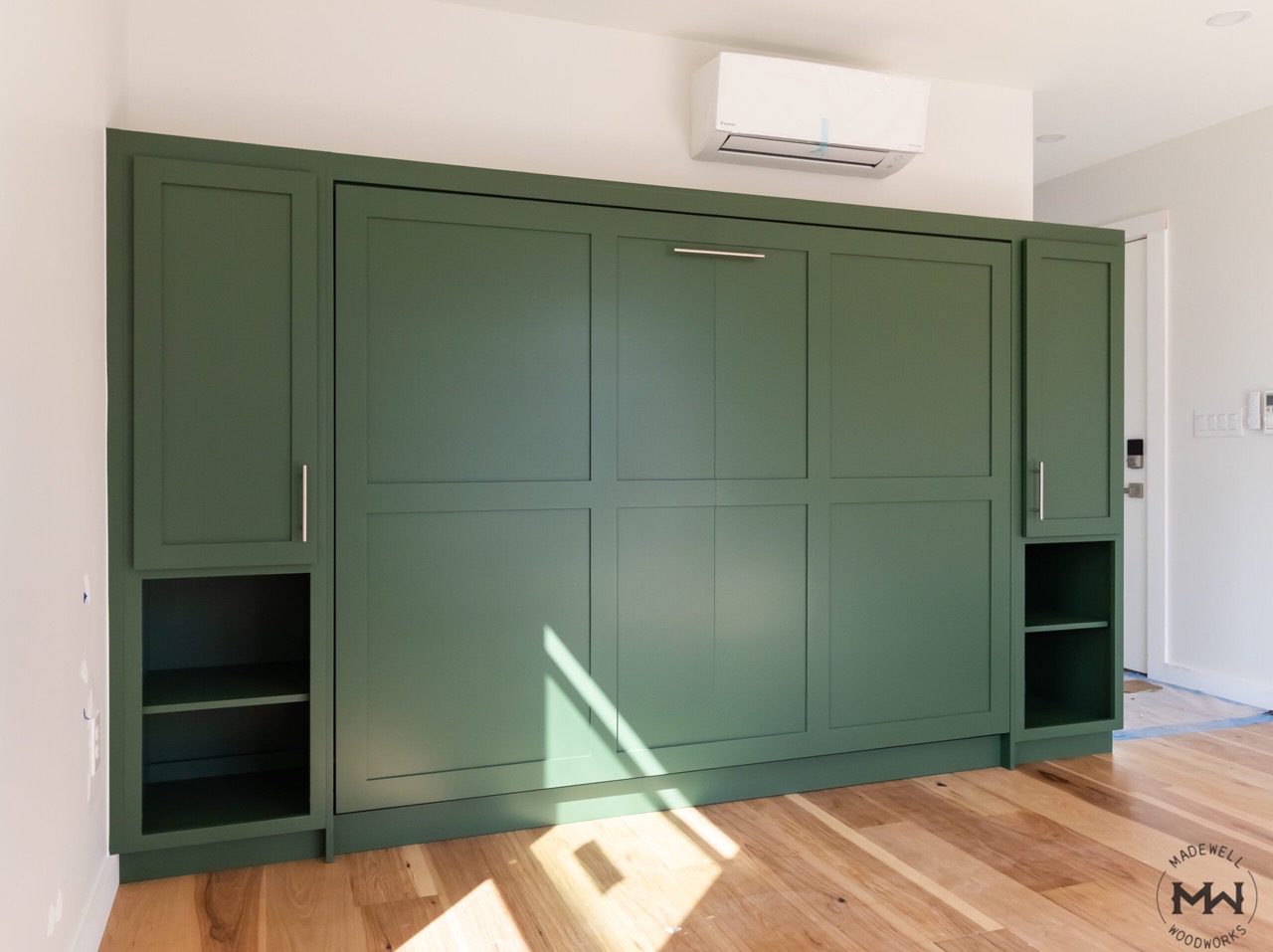
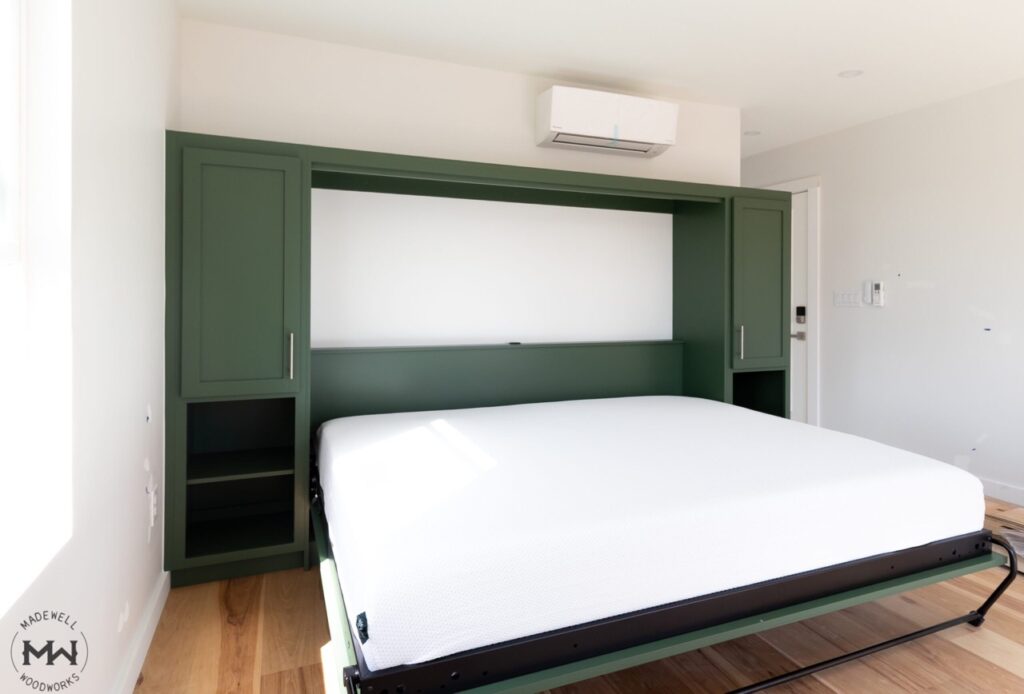
In the build featured in this post, the clients had a mini-split unit mounted on the upper wall of their guest room. A vertical Murphy bed simply wasn’t possible without relocating the unit. The horizontal orientation gave them a full queen bed, integrated storage on both sides, and a wardrobe-style valet bar, all without touching the HVAC.
2. It Looks Like a Piece of Furniture
When a horizontal Murphy bed is closed, it sits lower on the wall and reads differently than a vertical cabinet. The wide, low profile feels intentional and designed rather than like something being concealed. Paired with clean panel work, matching hardware, and flanking storage towers, it can look like a custom built-in wall unit that just happens to contain a bed.
That’s exactly the effect in the hunter green build shown here: Shaker-style panel fronts, polished chrome pulls, and open lower shelving on each side. Nothing about it says ‘this is a Murphy bed’ until the moment you pull it down.
3. You Can Put Things Above It
Because the cabinet sits lower on the wall, the space above a horizontal Murphy bed is genuinely usable. A wall-mounted TV, floating shelves, artwork, or even a narrow shelf for books and a lamp. None of these are possible above a vertical bed cabinet that runs nearly to the ceiling.
This makes horizontal beds particularly well-suited for rooms where you want the space to function as a living area, home office, or media room when the bed is up. The upper wall becomes part of the design rather than dead space.
4. Wider Rooms Get Better Use of the Wall
A horizontal Murphy bed typically spans 7 to 9 feet wide, including side storage towers, which suits wide walls naturally. If your room has more horizontal wall space than vertical, a horizontal bed fills it in a way that feels balanced. Pairing the bed cabinet with matching side cabinets creates a seamless wall-to-wall effect that makes the room feel intentional and complete.
5. It Can Include a Full-Size Work Surface
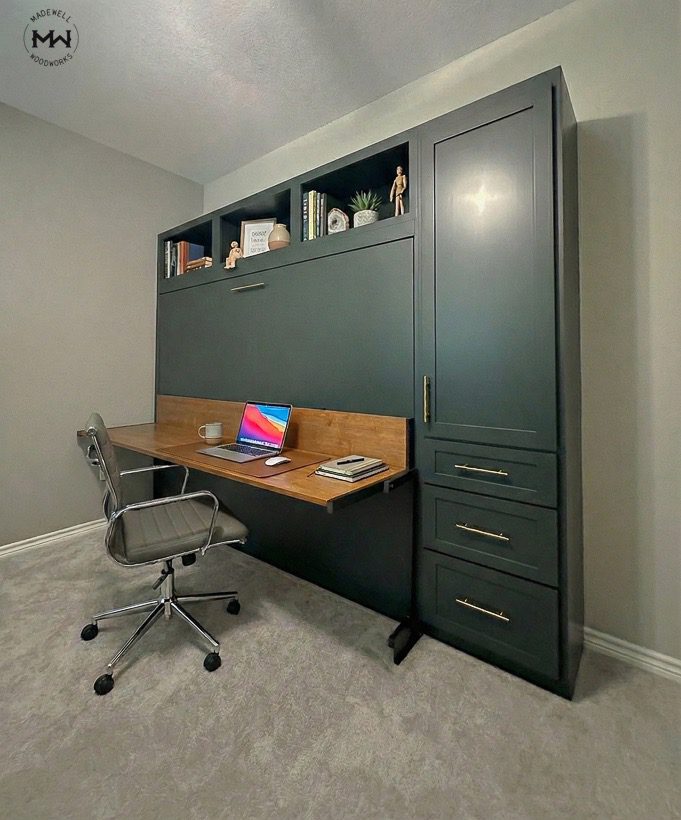
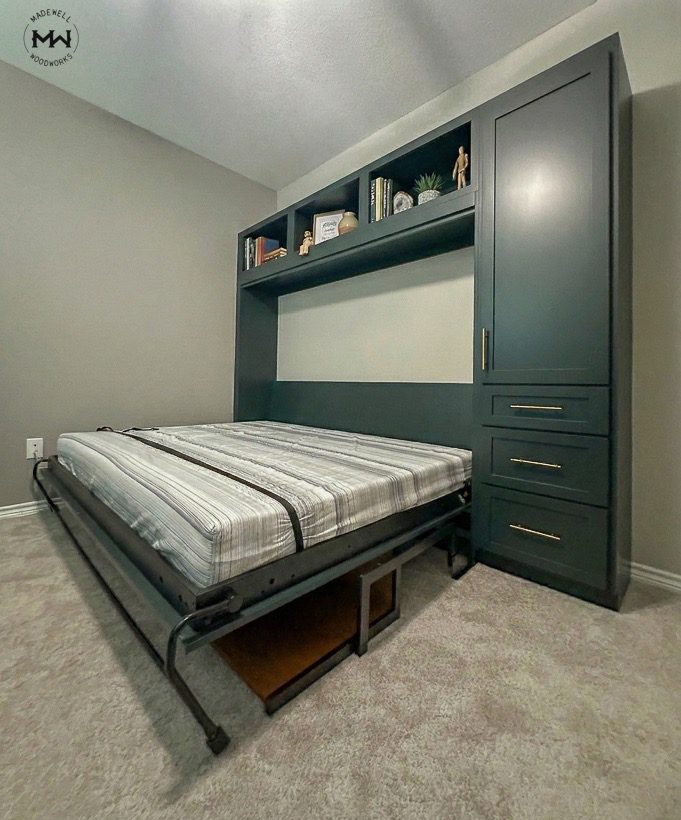
One of the most compelling upgrades for a horizontal Murphy bed is the stay-level desk option. A stay-level desk is a fold-down work surface built into the face of the bed cabinet that remains usable even when the bed is down. Lower the bed, and the desk is still right there beside it. Raise the bed, and the desk becomes your full workspace.
Because a horizontal bed’s cabinet sits lower on the wall, the desk can span the full width of the unit at a natural, ergonomic height. The result is a genuinely large work surface, not a cramped fold-out tray, but a proper desk that comfortably fits two monitors, a laptop, and a coffee.
This configuration is the gold standard for home offices that need to double as guest rooms. During the work week, you have a full desk setup with open shelving above for books, decor, and display. When guests arrive, the desk folds flat and the bed lowers in seconds.
The build shown here pairs the stay-level desk with a tall side tower that includes three full-depth drawers and a closed upper cabinet with display shelving above. The warm wood desktop against the deep green cabinet is a combination that feels intentional and designed, not like an afterthought conversion. This is a room that works hard every single day, in every configuration.
Horizontal vs. Vertical Murphy Beds: A Direct Comparison
Which Murphy bed orientation is right for you?
Horizontal
Vertical
Mini-split or other obstruction on wall?
Maximize attached desk width?
Limited floor length?
Maximize attached desk width?
Traditional Sleeping arrangement
Taller cabinetry to maximize storage?

Neither option is inherently better. The right choice comes down to your specific room: ceiling height, wall width, how the room is used day-to-day, and what you want it to look like when the bed is closed.
Built for Your Room, Not Against It
The best Murphy bed for your space isn’t the one that looks best in a catalog. It’s the one that was designed around the actual constraints and possibilities of your room: your ceiling, your wall, your HVAC, your style.
At Madewell Woodworks, every horizontal and vertical Murphy bed we build starts with a detailed conversation. We measure your space, talk through how you use the room, and design something that works with your home rather than in spite of it. All built in Austin, from real plywood, with hardware rated to last decades.
Whether you’re leaning horizontal, vertical, or still figuring it out, we’re happy to walk you through it.
Not Sure Which Style Is Right for Your Space?
We build custom horizontal and vertical Murphy beds for Austin homeowners and design professionals. Every project starts with a conversation about your room, your ceiling, and your goals.
Sorry, the comment form is closed at this time.